
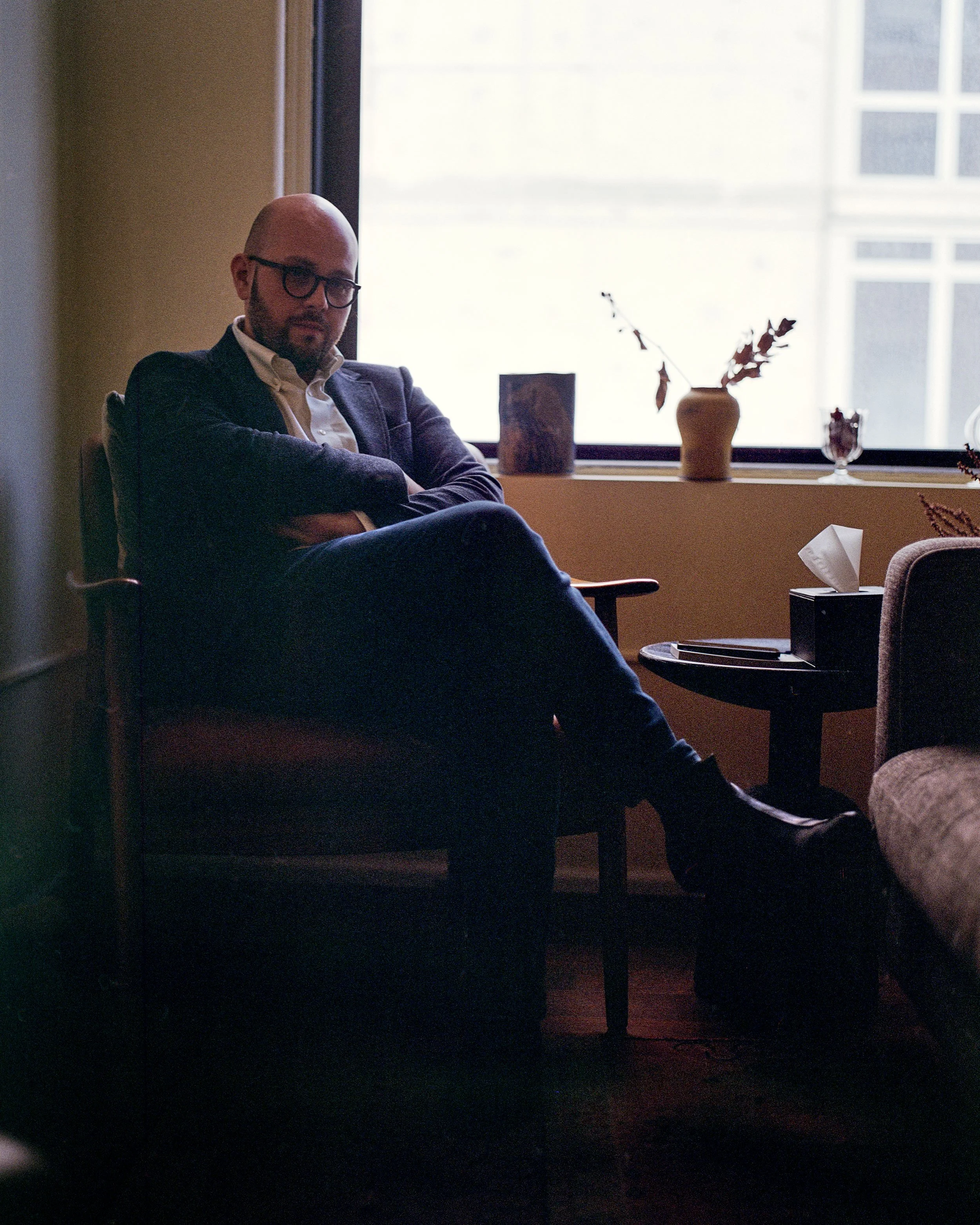
About Bryan
I am a psychoanalytically trained clinician in private practice in Midtown Manhattan. My work is grounded in contemporary psychoanalytic thought and informed by training across several analytic traditions. I treat psychoanalysis as a disciplined practice of listening and thinking with another person. It requires steadiness, careful attention, and a willingness to approach what is defended against, minimized, or prematurely resolved.
My clinical approach is shaped by close attention to the therapeutic relationship and the ways emotional life is communicated beyond content. I pay particular attention to how people manage dependence, anger, shame, desire, and vulnerability, as well as to the moments in which language breaks down and something more implicit takes over. I also take seriously the role of early relational experience in shaping present-day expectations of closeness, conflict, and recognition.

Background
I received my Master of Social Work from New York University and completed postgraduate training in psychoanalytic psychotherapy and psychoanalysis at the William A. White Institute, Institute for Psychoanalytic Training and Research (IPTAR), Après-Coup Psychoanalytic Association, and Pulsion: The International Institute of Psychoanalysis and Psychoanalytic Psychosomatics, where I also teach.
My analytic training has included sustained study of nonverbal communication, early relational experience, and the symbolic dimensions of psychic life. This includes how meaning is carried through dreams, fantasy, somatic experience, and the particular forms a person’s speech takes when emotion becomes difficult.
I have lived, studied, and worked in Israel, Argentina, and Brazil. These experiences continue to inform a culturally attuned and linguistically sensitive way of listening, particularly in relation to migration histories, family structures, religion, belonging, and the ways shame and loyalty shape identity. Aside from English, I speak Portuguese, Spanish and French, and am currently studying Arabic.
Approach
My work is typically intensive and ongoing. When appropriate, treatment involves meeting more than once per week as part of a psychoanalytic process. I do not work from a preset timeline or a standardized protocol. The structure of the treatment is shaped by the person’s difficulties and by what is required for the work to deepen rather than remain at the level of explanation.
Alongside my clinical work, I maintain an ongoing engagement with the arts and humanities and hold a Master of Arts in Performance Studies from NYU Tisch School of the Arts. This background supports particular attentiveness to language, embodiment, and expression, including the ways people communicate through rhythm, silence, gesture, and style. It also informs my work with patients whose lives involve leadership, public presence, sustained performance, or high-stakes decision-making, where the gap between external functioning and inner experience can become especially pronounced.
Practice
I maintain a private, out-of-network practice and work with a limited number of people at a time. This is an intentional structure. It allows for consistent scheduling, sustained attention, and a stable therapeutic frame. It also supports the privacy and discretion that many professionals and public-facing individuals require in order to speak freely.
Treatment begins with an initial consultation to determine whether this approach is a good fit. The consultation is used to clarify what is bringing you in now, how the difficulty has developed over time, and what you have tried already. We also discuss the structure of the work from the outset, including frequency, scheduling, and fee, so that the treatment begins with clear terms.
If we decide to proceed, we agree on a consistent meeting time. Frequency is discussed directly and determined by clinical need and practical feasibility. I do not define treatment by a fixed number of sessions. The work is organized around continuity and depth, because recurring patterns become visible and workable in a reliable setting over time.
I do not participate in insurance panels and do not bill insurance directly. If you have out-of-network benefits, I can provide documentation that you may submit for possible reimbursement, depending on your plan. Because my practice is intentionally small, openings can be limited. When I am full, I maintain a waitlist and can also provide referrals when appropriate.